
Jesus in Gethsemane painting
A Jesus in Gethsemane painting can become a gentle companion in the home, a quiet reminder of Christ praying alone in the night. Many Catholics place this image where they pass by often, letting it quietly invite them to remember that moment of surrender and trust.
On this page I simply share how a Jesus in Gethsemane painting can fit into everyday Catholic life: in prayer corners, bedrooms, and family spaces, without pressure and without promises, just as a steady reminder of the Lord’s presence in struggle and in peace.
Living with a Jesus in Gethsemane painting at home
Among the many images of Christ, the scene of Jesus praying in the Garden of Gethsemane feels especially close to the hidden worries and quiet burdens of everyday life. A Jesus in Gethsemane painting does not only decorate a wall; it can become a simple way to remember that the Lord also knew fear, loneliness, and heaviness of heart, and still turned everything into prayer.
I have had a Jesus in Gethsemane painting near my bedroom door for several years now. It is not a large or impressive picture, but I pass it every night when I turn off the lights. Often I pause for just a second, look at Jesus kneeling among the dark trees, and whisper a short prayer: “Lord, stay with me tonight.” This small habit has slowly become part of my rhythm, almost like breathing.
When we bring this scene into our homes, we are not trying to recreate the Garden itself. We are simply allowing our walls to speak softly of that moment when Jesus said, “Not my will, but yours be done,” even when everything felt heavy. The image can quietly accompany us when we do not know what to say, or when words feel too big.
What this scene of Jesus in Gethsemane holds
The Garden of Gethsemane is one of the most human moments in the Gospel. Jesus is not surrounded by crowds or preaching from a boat. He is not working a miracle. He is simply kneeling in the dark, knowing what lies ahead, and choosing to stay close to the Father. A painting of this moment can gently remind us that real faith is often quiet and hidden.
If you look closely at most paintings of Jesus in Gethsemane, you will notice a few common elements: the dark sky, a sense of solitude, the tired disciples in the background, and sometimes an angel, or a beam of light, or a chalice symbolizing the suffering to come. These details are not there to frighten us. Instead, they show that even when the night is real, so is the Father’s presence.
For many of us, daily life is full of small Gethsemanes: the worry about a child, tension at work, a health concern that lingers, or the simple anxiety that comes in the quiet hours. Having a Jesus in Gethsemane painting nearby can nudge us gently toward prayer, helping us to remember that we are not the first to feel this way, and we are not alone in it.
Sometimes I sit in my living room after a long day and catch sight of the painting on the opposite wall. I do not always have the energy for long prayers, but I can at least look at Jesus kneeling and say, “You know.” That simple exchange, almost wordless, is often enough to reset my heart, even if my circumstances do not change.
Placing a Jesus in Gethsemane painting in your home
Choosing where to hang a religious image is a quiet, personal decision. There is no perfect rule, but there are some thoughtful places where a Jesus in Gethsemane painting often seems to belong:
- Near a favorite chair or prayer corner – so the image can stand beside you during moments of quiet reflection.
- In a bedroom – especially near the door or opposite the bed, as a reminder at the end of the day.
- By a desk or workspace – to remember Christ’s silent strength during stressful projects or decisions.
- In a hallway – where you and your family pass many times a day, allowing the image to accompany your routines.
In my own home, the Jesus in Gethsemane painting ended up in the hallway almost by accident. At first I thought it should go in a more obviously “holy” spot, but the hallway is where I hurry past with laundry, school bags, and grocery bags. Seeing Jesus there, in the middle of all that ordinary movement, has been a quiet blessing. It reminds me that His night in the garden was also surrounded by very human things: dusty feet, tired friends, and the press of time.
Wherever you place the painting, what matters most is that it feels natural and peaceful. It should not feel like a decoration that demands attention, but like a familiar presence in the room, available whenever your heart turns toward it.
Different styles of Jesus in Gethsemane painting
Not every Catholic home looks the same, and not every painting of Jesus in Gethsemane has the same style. Some are more traditional, others more modern or minimal. Each can serve quiet prayer in a different way:
- Classic, detailed paintings – Often rich in color and texture, showing the folds of Christ’s robe, the trees of the garden, and the distant city lights. These can draw you into the scene as if you were standing close by.
- Softer, peaceful interpretations – With muted colors and gentle light, these can feel comforting, emphasizing Christ’s calm trust more than the intensity of the struggle.
- Simple, modern designs – Sometimes with fewer details or softer lines, these may blend naturally into a contemporary home, while still keeping the heart of the story.
- Triptychs or multi-panel pieces – A single scene spread across two or three panels, offering a sense of movement and space on the wall.
I once visited a friend whose Jesus in Gethsemane painting was very different from mine. It had cool blue tones and a gentle, almost quiet light around Christ. At first I thought I preferred bolder colors, but as we prayed a short decade of the Rosary together in that room, her painting’s calmness matched the silence so well. It reminded me that different images speak to different hearts, and that is all right.
If you are unsure about style, you might simply ask yourself: “Could I sit quietly in front of this for a few minutes and feel at peace?” That question often says more than any detailed explanation.
Images for reflection: Jesus in Gethsemane at different moments
Visual details can gently guide the way we pray in front of a Jesus in Gethsemane painting. Some images focus on Christ’s face, others on His posture in prayer, and others on the contrast between light and darkness. Here are a few ways such images can invite reflection.

In some paintings, Jesus is shown looking upward, His hands folded or resting on a rock. These details can quietly remind us that prayer is not always about feeling strong; sometimes it is simply about turning our gaze toward the Father, even when we feel fragile.

Other paintings highlight the dark trees, the distant city, or the sleeping disciples. I sometimes find myself drawn to those tiny figures in the background. They remind me that even when people close to us do not fully understand what we are going through, Christ stays awake with us.

Sometimes, during a difficult season, I would sit facing my Jesus in Gethsemane painting and simply breathe. I did not always say specific prayers; I just sat with Him. Over time, that painting came to feel like a familiar friend, always kneeling, always present, always quietly turning everything into trust.
Using a Jesus in Gethsemane painting during prayer
Catholics often use sacred images as gentle helps for prayer. We do not look at them as magic or as replacements for God, but as reminders of real moments in Christ’s life. A Jesus in Gethsemane painting can be especially helpful when our hearts feel heavy or scattered.
Here are a few simple ways people sometimes pray with this image:
- Beginning and ending the day – Pausing for ten or twenty seconds in front of the painting in the morning, and again at night, simply asking Jesus to stay close in whatever the day or the night brings.
- During the Rosary – Many Catholics meditate on the Agony in the Garden during the Sorrowful Mysteries. Having the painting nearby can help hold attention and give a concrete face to that mystery.
- In times of decision – When facing a difficult choice, some people stand or sit before the painting and ask for the courage to accept God’s will with honesty, even when they do not know what will happen.
- When words are hard – On days when prayer feels dry, simply sitting in silence before the image can be enough. The painting “holds the place” of prayer while the heart slowly opens.
I remember one evening when a close family member received worrying medical news. I walked around the house not knowing what to do with myself, and I ended up sitting on the floor beneath my Jesus in Gethsemane painting. I did not manage to pray long formal prayers, but I kept repeating, “Be with them, Lord.” Somehow, seeing Him continue to pray in the darkness helped me stay there in prayer too, even if all I had were a few stumbling words.
A painting cannot fix our problems, and it does not take away the weight of suffering. But it can remind us that Christ has already stepped into the darkest places before us, and that He carries our struggles into His own prayer.
Jesus in Gethsemane painting in family life
A Jesus in Gethsemane painting can also quietly shape the atmosphere of a home where children, teens, or elderly family members live together. It does not need to become a constant lesson or a focus of attention. Simply being there on the wall can be enough.
Children sometimes ask honest, simple questions, like “Why does Jesus look sad?” or “Why is it dark?” These moments can open gentle conversations about how Jesus understands our feelings, even when we are scared or tired. We do not need to give long explanations. A short reply, such as “This is when Jesus prayed very hard at night before everything that would happen the next day,” might be all that is needed.
Teenagers, who often carry unspoken worries, might not comment much on the painting, but they notice it. A friend once told me that as a teenager she would stare at her family’s Jesus in Gethsemane painting late at night, after everyone else had gone to bed. She said it was the one place in the house where she felt truly seen, without anyone asking her to speak.
For older family members, especially those who remember traditional devotions like the Holy Hour, the image of Gethsemane can bring back memories of quiet nights of prayer before the Blessed Sacrament. A painting at home cannot replace that experience, but it can echo it gently, reminding them that the Lord still keeps watch with them.
Art, tradition, and the story behind Gethsemane
The scene of Jesus praying in the garden has inspired Christian art for many centuries. From early icons to modern paintings, artists have tried to show the depth of that night: the fear, the obedience, the loneliness, and the nearness of the Father. Knowing a little of this tradition can help us appreciate a Jesus in Gethsemane painting more deeply.
Many paintings are influenced, directly or indirectly, by the Gospel accounts and by long reflection in Christian spirituality. If you are interested in the biblical background of the scene, you might find it helpful to read the sections describing the Agony in the Garden from time to time, perhaps sitting where you can see your painting while you read.
Over the years, I have noticed that my own feelings toward my Jesus in Gethsemane painting change with the seasons of my life. During peaceful times, I see mostly the soft light around Christ. During harder times, I notice the shadows and the distance between Him and His sleeping friends. The painting has not changed, but my heart has, and the image continues to meet me where I am.
This is one of the quiet gifts of sacred art in the home: it stays, even when we do not give it much attention. Then, suddenly, on a day when we are hurting or searching, it is there to catch our gaze and gently turn it toward God.
More visual variations on Jesus in the Garden
Some Catholics appreciate having more than one visual take on the same mystery. Different Jesus in Gethsemane paintings can highlight different aspects of the night: Christ’s surrender, His loneliness, or the quiet strength of His prayer.

Another image might show the angel comforting Jesus, with a cup or chalice in His hands. This can bring gentle attention to the way Christ accepts what is coming, not with cold resignation, but with love that is willing to go all the way for our sake.
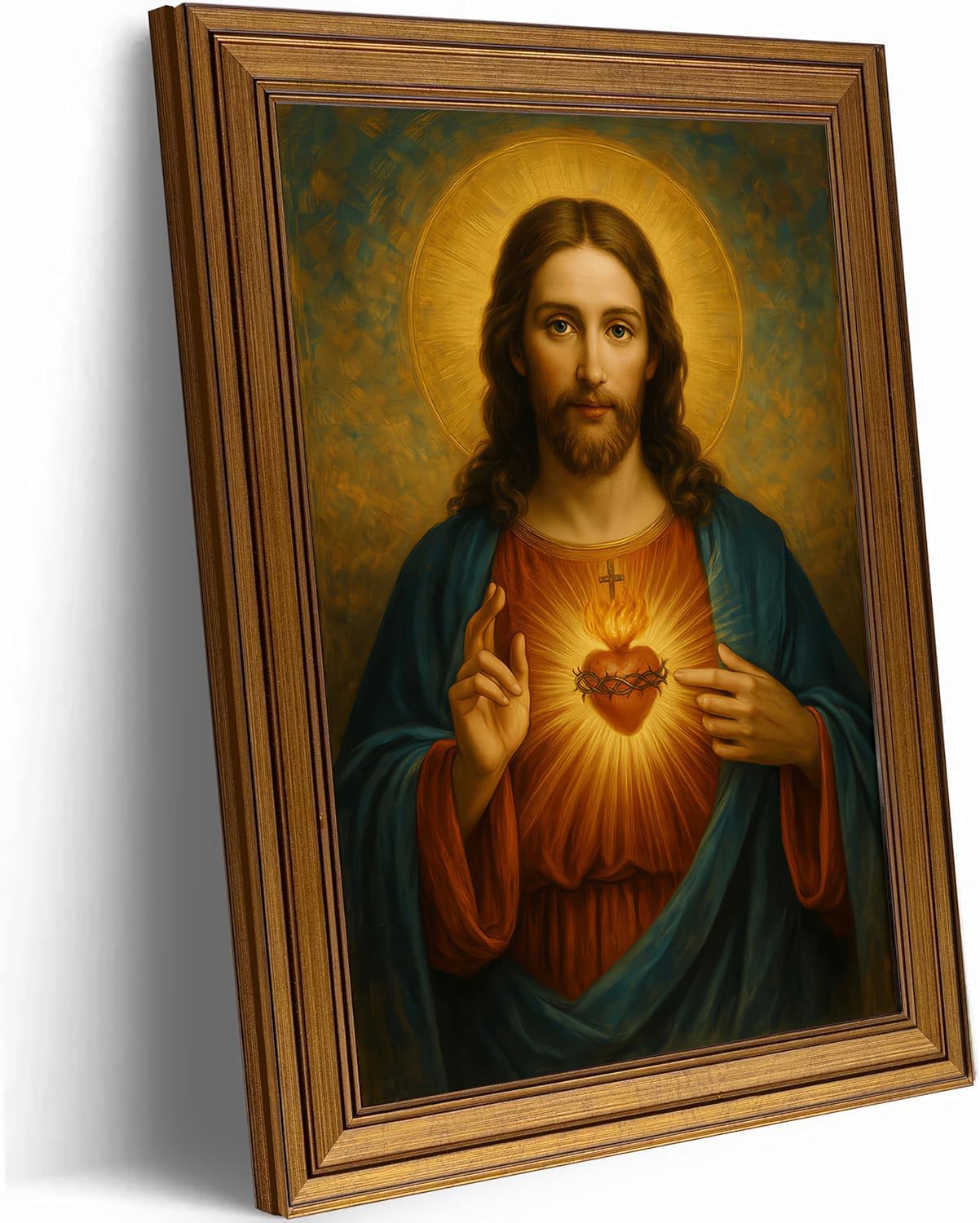
And yet another style may keep the focus very close to Christ’s face and shoulders, as if we were right beside Him. This kind of painting can help us imagine simply being with Him in the garden, not fixing anything, not explaining anything, just staying near.
When I first chose a Jesus in Gethsemane painting, I thought carefully about colors, size, and frame. Over time, those details have faded into the background. What remains is the steady presence of Christ praying in the night, and the way that presence quietly supports my own prayer.

Simple care and framing for your painting
Once a Jesus in Gethsemane painting is part of your home, a bit of simple care can help it stay beautiful for years. Most prints or canvases only need occasional dusting with a soft, dry cloth. Avoid harsh chemicals or rough sponges, which can scratch or dull the surface.
Framing is also a personal choice. Some people prefer a simple wooden frame that matches the furniture; others like a more ornate, traditional frame that sets the image apart. Both approaches can work well. What matters is that the frame supports prayer rather than distracting from it.
It can be helpful to hang the painting at eye level where you naturally stand or sit, so you do not have to strain your neck to look at it. Good, gentle lighting—natural light by day or a soft lamp at night—can also make the image easier to pray with.
Every once in a while, when I dust the frame of my own Jesus in Gethsemane painting, I find myself pausing and saying a short prayer while I do it. Caring for the image becomes a small way of caring for the place it holds in my life of faith.
FAQ about Jesus in Gethsemane paintings
1. Is it appropriate to have a Jesus in Gethsemane painting in a bedroom?
Yes, many Catholics find it very natural to place a Jesus in Gethsemane painting in the bedroom. The end of the day often brings tiredness, worries, and questions. Seeing Christ in prayer before you go to sleep can gently invite you to hand those things over to God. If the image brings peace and helps you remember the Lord’s presence, it is a fitting place for it.
2. How can I pray with this painting if I am new to prayer?
You do not need special words or long prayers. You might simply stand or sit in front of the painting, look at Jesus, and tell Him in your own words what is on your heart. Even a short phrase like “Jesus, stay with me” or “Help me trust You tonight” is enough. Silence is also a real form of prayer. You can just be there with Him in the garden.
3. Is a Jesus in Gethsemane painting only for times of suffering?
While the scene of Gethsemane is certainly about suffering and struggle, it is also about love and trust. Many people keep this painting on their wall during peaceful times as well, to remember that Christ’s “yes” to the Father’s will is at the heart of every day, not just the difficult ones. The image can speak of quiet faith even when life is calm.
4. Can this image be part of a family prayer corner with other devotions?
Yes, a Jesus in Gethsemane painting often fits very well into a small home prayer corner together with a crucifix, a Bible, a candle, or a statue of Mary. The scene of the garden connects naturally with the Sorrowful Mysteries of the Rosary and with traditional devotions like the Holy Hour. You can arrange the items in whatever way feels respectful and balanced.
5. What if a family member finds the image too intense or sad?
It can happen that someone in the home feels uneasy with certain images of Christ’s suffering. In that case, it may help to choose a gentler style: softer colors, a calmer expression on Jesus’ face, or a composition that emphasizes light more than darkness. You might also talk simply about how Jesus understands our sadness and stays near us in it. The goal is not to disturb anyone, but to let the painting quietly support faith and trust.